




With hardly any other item of clothing does the price tell you as little about quality as with a leather belt. For 15 euros you get one that splits along the row of holes after a year — and for 90 euros you sometimes get the same thing with a nicer buckle. In between are belts that last twenty years. On the shelf they all look alike. The difference lies in details you have to know about in order to see them.
This guide goes through those details: cut edge, material thickness, grain, edge finishing, buckle, holes. You'll learn how to check a belt in the shop in one minute, what to look at online instead, and how to tell after three years whether you got it right. Width, length and fit are kept short here — for that there is the separate guide Men's Leather Belts: Leather, Width, Length and Fit.
Full-Grain, Split or Bonded Leather: The Cut Edge Gives It Away
Three terms on the label sound similar and mean the opposite of one another. Full-grain leather — also called full cowhide or grain leather — is the upper layer of the hide with its natural surface, at full thickness, without splitting. That's the material a belt should be made of if it has to withstand pull every day. Split leather is the lower layer left over when a thick hide is split: no natural surface, a loose fibre structure, and therefore coated with a plastic layer and embossed with a grain. And Bonded leather, as leather fibre material is usually called in the trade, is not leather in the true sense, but ground-up leather scraps pressed into a sheet with a binding agent and laminated with a film on top. Under the leather labelling standard it may not be sold as leather — it is advertised that way all the same.
From the top all three look the same; from the side they don't. Turn the belt over and look at the cut edge at the tip:
- Full-grain leather: a continuous, dense cross-section of fibres in the colour of the leather or slightly lighter. No layers.
- Split leather: a thin, smooth top coat on top, a lighter, looser material underneath. You can see the transition as a fine line.
- Bonded leather: a uniform, almost cardboard-like edge with no fibre direction, a film on top that is often already lifting at the tip.
- Multi-layer belts: thin leather on the outside, any material in the middle, thin leather on the inside, glued and stitched all the way round. The seam doesn't run around the belt for decoration, but because the glue alone won't hold.
A belt made from a single piece of full-grain leather doesn't need a seam all the way round. If you see one, it's not a flaw, but a reason to look more closely. How real leather differs from imitations in general is covered in detail in the guide How to Recognise Real Leather. Here it's about what counts specifically on a belt.
Material Thickness and Grain: What 3 to 4 Millimetres Mean
Thickness
A men's belt made from a single piece of leather is usually between 3 and 4 millimetres thick. Below that, at 2 to 2.5 millimetres, a single-layer belt goes soft and stretches; from 4.5 millimetres you're into work and tool belts that won't fit through any normal trouser loop. More important than the number is whether the thickness comes from one piece or from layers: a three-layer belt of 4 millimetres ages at the glue lines, a single-layer one of 3.5 doesn't.
You can measure that without callipers, too: a 2-euro coin is 2.2 millimetres thick, and a good belt is noticeably thicker. A note on our own behalf: for the belts in our range we don't state a material thickness in millimetres, because it isn't documented as a data-sheet value. The same goes for the question of whether a leather is full-grain or corrected — that isn't stated in any of our descriptions, and we'd rather not claim it than guess.
Grain
The grain is the pattern of the surface: pores, fine creases, small irregularities. On natural leather it never repeats. On embossed split leather and on plastic it comes from a roller, and if you scan twenty centimetres of belt you'll find the same pattern a second time. On coarse-grained buffalo leather you can see the irregularity with the naked eye; on finely finished cowhide you have to look closer. Which animal brings which grain, and why cowhide is so common for belts, is explained in the comparison of leather types.
Deliberate embossing such as croc or leopard looks is a case of its own: those repeat by nature and say nothing about the base material. Whether there's cowhide underneath or split leather, you can again only tell from the cut edge.
The Edges: Cut, Dyed, Polished
The edge is the quickest way to tell how much work went into a belt — and the quickest thing to fail if none did. After being cut from the hide it is raw, fibrous and absorbent. What happens next separates three grades:
- Cut only: The edge stays raw. It soaks up water and dirt, frays at the tip and goes fuzzy at the loop after a year. Intentional on very rustic belts; on everything else, a sign of cost-cutting.
- Cut and dyed: The edge is sealed with edge paint, usually in the tone of the leather or slightly darker. That closes the fibres and looks clean. Whether the paint holds you can see on the inside of the buckle fold: if it's already cracking there in the shop, it will crack everywhere.
- Rounded and polished: The edge is bevelled, i.e. slightly rounded, then smoothed with wax or gum arabic and rubbed to a shine. Feels smooth and tends to get better-looking over the years. The most elaborate option, rare on belts under 30 euros.
Run your thumbnail along the edge. If it catches, the edge is raw or the paint is only sitting on top. If it glides, the edge has been finished. And look at the tip: that's where two edges meet in a curve, and that's where any carelessness shows first.
The Buckle: Pin Buckle, Material, Interchangeable Buckle
The Design
The pin buckle is the standard solution for everyday belts for good reason: it has no mechanism that can wear out. A frame, a pin, done. Automatic buckles with a toothed track adjust steplessly, but the track is glued onto the back of the leather — and the leather underneath is often thin split leather, because the track takes the load. Clamp buckles put more strain on the leather at the clamping point.
The Material
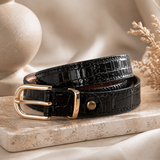
A good buckle is made of solid metal, usually brass or plated zinc die-cast, and feels correspondingly heavy. You can spot hollow-cast buckles by their weight and by the pin having play in its eye. If you react to nickel, ask before buying — the information is rarely given voluntarily. For our Kroko Ratschkatl Belt it is explicitly stated that the buckle is not nickel-free; for the other models no information is available.
Interchangeable Buckle or Fixed Rivet
How the buckle is attached to the belt decides whether you can shorten it yourself and swap the buckle. Screw rivets or a press stud can be undone: buckle off, cut a piece off the buckle end, punch a new pin hole, buckle back on. Hollow rivets or stitching are fixed — then shortening is a job for the cobbler. That says nothing about the leather, but a lot about everyday use: with a second buckle, the jeans belt becomes a suit belt.
Holes, Shortening and Width
The Holes
Five holes spaced about 2.5 centimetres apart are the standard, and the middle one is the target hole. Cleanly punched holes have a smooth, closed rim; frayed ones tear more quickly because the fibres at the rim are already damaged. Oval holes are better than round ones: the pin sits in the direction of pull, and the rim of the hole gets stretched less. The distance from the hole to the outer edge should be at least as large as the hole itself — a row of holes set too close to the edge is the most common breaking point of all. Why belts tear precisely there and how you can delay it is covered in the article Caring for Leather Belts.
Shortenable Means: At the Buckle End
Shortening is done at the buckle end, never at the tip: the tip is shaped and finished, the buckle end disappears in the fold. All belts in our range can be shortened yourself. That takes the pressure off the length question: if you're between two sizes, take the larger one and shorten it. Lengthening is never possible.
3.5 or 4 Centimetres
Width is not a question of quality but of fit, so just the essentials. 4 centimetres fit through the loops of jeans, chinos and work trousers and are the standard width for everyday belts; all four men's models among our men's leather belts are 4 cm wide. Suit trousers often have loops for 3 to 3.5 centimetres — a 4 cm belt ripples there. Hold a ruler against the loop before ordering; everything else on waist size and fit is in the guide linked at the start.
The Test in the Shop, the Test Online and the Test After Three Years
In the Shop: One Minute, Three Moves
Bend. Bend the belt sharply over your thumb, grain side out. Full-grain leather throws fine, irregular creases; oiled leather lightens at the bend and darkens again when you let go. Split leather with a top coat shows small white cracks in the surface at the bend or creases like cardboard. Bonded leather creases and keeps the crease. Then the other way round: the back should be fibrous, not smooth like fabric.
Smell. Less reliable than everyone claims, but useful as a knockout criterion: if a belt smells sharply of solvent or plastic, leave it. Depending on the finish, leather smells warm, fatty or of almost nothing — a neutral smell is no counter-evidence.
Edge. Look at the cut edge at the tip, run your thumbnail along the long edge, check the inside of the buckle fold for flaking paint. Twenty seconds that say more than any label.
Online: What the Product Page Has to Provide
Online, bending and smelling are off the table. Instead you have the description, and it has to answer three questions. First, the animal type: “cowhide” or “buffalo leather” is a statement, “genuine leather” alone is not — split leather may also be sold as genuine leather. Second, the finish: “oiled”, “matt”, “natural” points to an open surface where you can still see the leather; if there's no information at all, the surface is often covered with an opaque lacquer. Third, photos of the edge and the back — and if there aren't any, that's an answer in itself. With reviews, the number counts more than the rating — and whether someone wrote again after a year.
After Three Years: How a Good Belt Ages
A belt made of full-grain leather doesn't get worse over the years, it gets different. The surface darkens where it's handled and at the loop, because skin oils and friction compact it. The favourite hole stretches slightly oval, the fold at the buckle softens, the tip shines from being pulled through. That's patina — and on open-pored, oiled leather it develops faster and more visibly than on finely finished cowhide, which looks new for longer. A bad belt, by contrast, ages in layers: the top coat cracks at the bend, the edge goes fibrous, the glue between the layers lets go, and at some point the film hangs off the tip. Anyone who has seen the difference once buys differently.
Which Belt from the Range for What
Finally, our own belts, judged by the same standards. Hodalump has been a family business since 1947, but that's not an argument — the edge is. The material details are taken from the product pages; where they only say “genuine leather”, we don't say more here either. All are in the same price range, under 30 euros.
For jeans and everyday wear: the Belt Brown made of cowhide, 4 cm wide, with a classic metal buckle and five pre-punched holes, shortenable yourself. It's the most-reviewed belt in the range; it shares that rating with the Belt Black — the same construction, matt surface, solid metal buckle, listed in the description as genuine leather. For the office, black is the quieter choice.
For travel: the belt with a hidden compartment, made of oiled buffalo leather. Coarse-grained, thicker in the hand, with a flat pocket for banknotes on the inside. The oiling brings the quick patina — and the note from the product description that it can rub off on light fabric. The wrong choice with white chinos.
If you only want one belt: the belt in 2 colours, a reversible belt made of genuine leather with black on one side and brown on the other. The reversible function means a bit more mechanism at the buckle than a pure pin buckle; in return you save yourself the second belt.
For slimmer waist sizes from 70 cm: the Ratschkatl models. Ratschkatl Belt Classic, Kroko Ratschkatl Belt and Leo Ratschkatl Belt are made of cowhide with a fine or embossed texture, have a pin buckle in gold or silver colour and start at waist size 70 cm. With their accent buckle they go better with jeans and evening outfits than with a suit. On the Kroko model the buckle is not nickel-free, and the width is not properly recorded for these models — the product photo helps here.
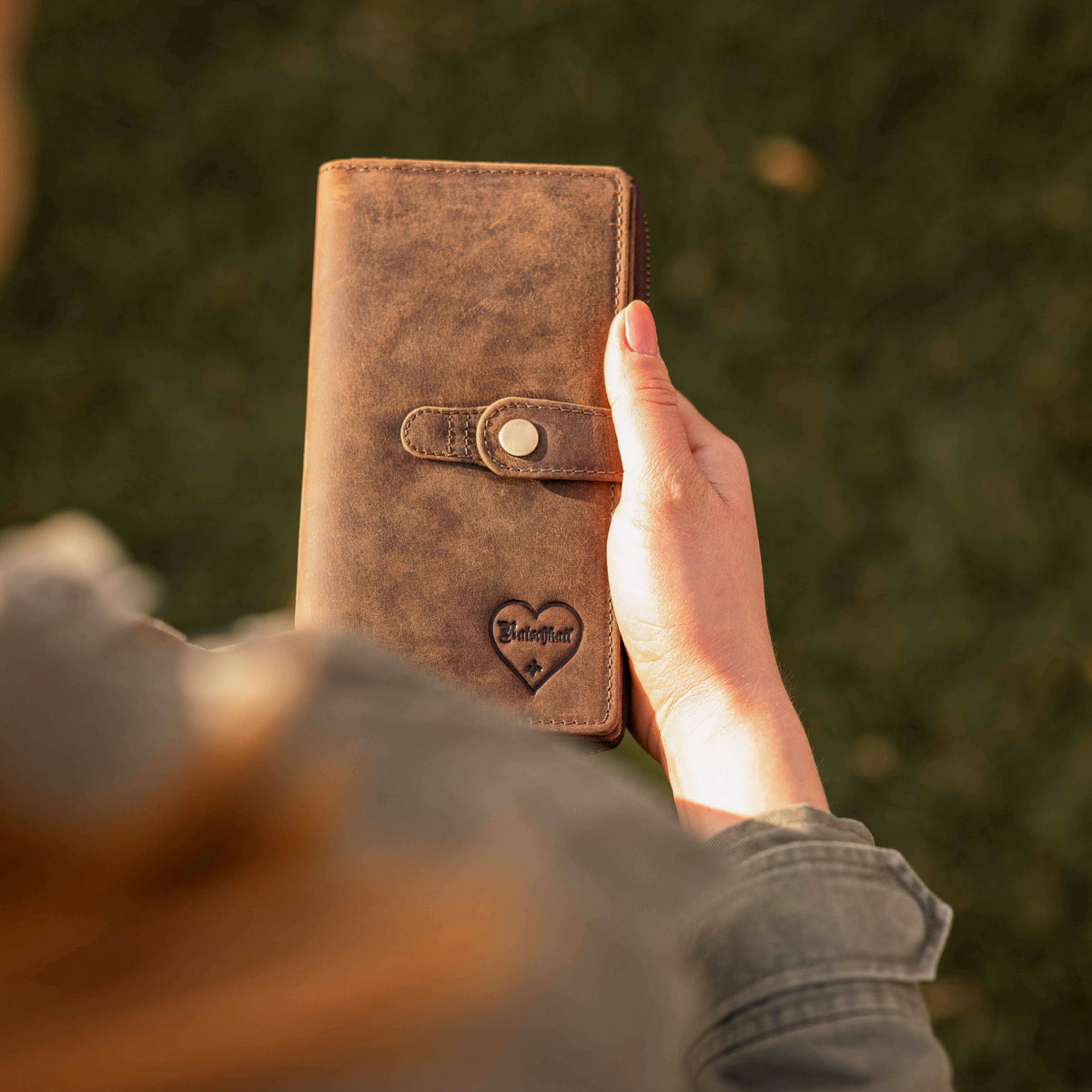
What none of them is meant for: weight training. The weightlifting belt in the range is a different tool with a wide back section, won't fit through any trouser loop and is therefore listed under clothing, not under the genuine leather belts. And if you're ordering anyway: a belt and wallet in the same colour are the most unobtrusive set a man can wear — you'll find the matching men's wallets in their own collection.
Conclusion
Quality in a leather belt isn't in the price or the label, but in four places you can check yourself: the cut edge shows whether it's one piece of full-grain leather or a layered build. The long edge shows whether anyone kept working after cutting. The buckle shows by its weight whether it's solid, and by its fastening whether you can shorten the belt. The holes show, by their rim and their distance from the edge, whether the belt will tear there. In the shop: one minute of bending, smelling, looking at the edge. Online: insist on animal type, finish and edge photos. A belt that passes this test ages into patina rather than into layers — and if you then pick the right length and grease it twice a year, you've dealt with the subject for a decade.