





“Medium-sized” is the most popular size label for women's wallets – and the vaguest. There is no standard for it. One maker calls 13 centimetres medium-sized, the next calls 18 medium-sized. Anyone searching for a medium-sized wallet usually means something very specific: it should fit in the bag you carry every day and still hold all your cards without creasing banknotes. This is exactly where most purchases go wrong, because the wallet is chosen by its compartments and the bag only has its say once you get home.
This guide reverses the order. First you will learn what outer dimensions “medium-sized” means in practice – derived from the real measurements of our models. Then we go through the four bags women's wallets actually live in: crossbody, handbag, tote and jacket pocket. We also cover why the format (portrait or landscape) often matters more than the centimetres, what fits into the medium class, which type of closure suits which daily routine – and, honestly, when you are better off buying small or large.
What “medium-sized” really means for a women's wallet
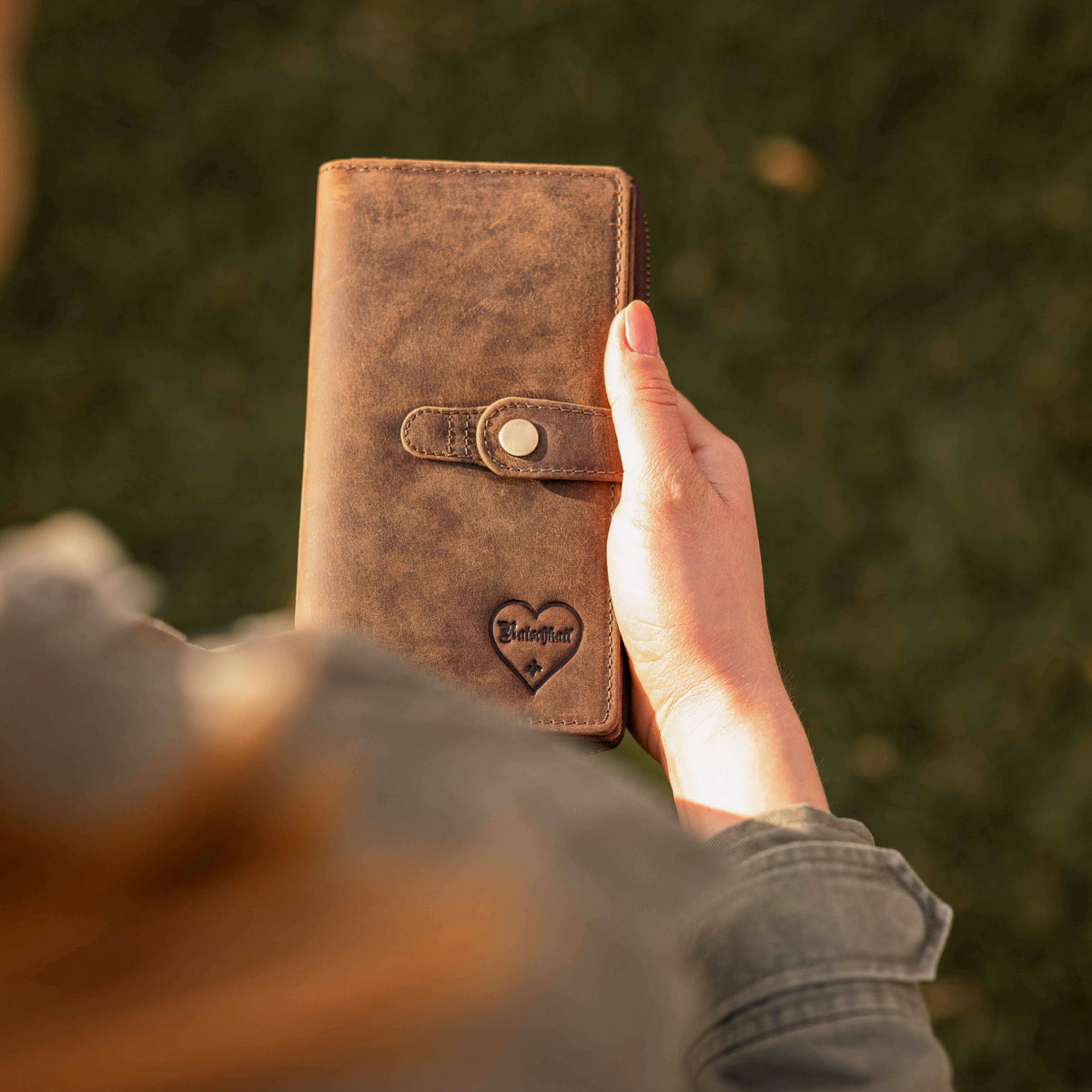
We laid the dimensions of all the women's wallets in our range side by side. A clear range emerges: everything we list as medium-sized has a long side between 13 and 16 centimetres, a short side between 9 and 10.5 centimetres and a depth of 2.5 to 3.5 centimetres. The medium-sized wallet Babsi measures 10 × 16 × 3.5 cm, the medium-sized wallet Resal 16 × 10 × 3.5 cm, Uschi 13 × 10.5 × 2.5 cm, Miri 9.5 × 13 × 3 cm and Andrea 15.5 × 10 × 3 cm.
For context, the neighbours: small wallets are 11 to 12 centimetres long (the jeans wallet Madl measures 11 × 7.5 × 2 cm, the small wallet Ratschkatl 11.5 × 8.5 × 3 cm). Large wallets start at 17 centimetres and go up to 20: Theresa 17 cm, Walli and Zenta 18 cm, Soferl and Gretl 19 cm, the large Gretl 20 cm. So the line between medium-sized and large is not a question of one more centimetre of leather, but of whether a euro banknote fits in flat. A 20-euro note is 13.3 centimetres long, a 50 is 14 centimetres. Only from about 16 centimetres of inner length do notes really lie flat. Below that they are folded once – that is the real difference between the classes.
So wherever you read “medium-sized”, check the number behind it: above 17 centimetres it is a large wallet, below 12 a small one, whatever it is called. All models from our women's wallets collection carry their dimensions on the product page so you can compare exactly that.
Which size fits which bag
A wallet is not carried in the hand but in a bag. That is why the bag is the first question, not the wallet. Measure the inside width of your everyday bag before you read on – with a ruler, not by feel. Seams, the zip pocket and your phone take away more of it than you would think.
Crossbody and phone bag
Small crossbody bags are often only 17 to 20 centimetres wide and 11 to 13 centimetres high inside, because they were designed around a smartphone. A medium-sized wallet in landscape format at 16 centimetres fills such a bag completely, and the phone has to go into the outer slip pocket. A better fit here is a portrait format 9.5 to 10 centimetres wide: it stands next to the phone instead of lying underneath it. Miri (9.5 cm wide) and Babsi (10 cm wide) are built for this. If your crossbody is even narrower, the small formats are right for you; with phone bags that have their own card slot, a card holder is often enough.
The classic handbag
Top-handle bags and shoulder bags between 25 and 32 centimetres wide are the home of the medium-sized wallet. Here the landscape format fits flat on the bottom or stands upright against the side wall without pressing. Resal, Uschi and Andrea lie flat, Babsi stands upright – both work. What matters is that the wallet does not have to be squeezed in on its end, but has room in the direction you pull it out. A wallet that catches on the bag's zip when you take it out is one centimetre too large.
Tote and large shoulder bag
In a tote, a medium-sized wallet gets lost. It slides to the bottom between laptop, water bottle and jumper, and you search for it blind. This is where the large format plays its advantage: a 19-centimetre wallet like Soferl you grab without looking. If you still want to carry medium-sized in a tote, choose a bag with an inner pocket and keep the wallet firmly stationed there. Everything about the large class is in the guide Large women's wallet: how many compartments you need.
Jacket pocket and coat pocket
Walking the dog, the bakery, sport: there are many trips without a bag. A jacket pocket usually takes 12 to 14 centimetres of width, a coat pocket a little more. A landscape format of 16 centimetres will not fit, a portrait format of 10 × 16 only in the coat pocket. If you regularly take your wallet along without a bag, the compact end of the medium class is right: Uschi at 13 × 10.5 cm, Hilde at 13 × 9 cm – or a small model straight away.
Landscape or portrait: the format counts more than the centimetres
Babsi and Resal are both 16 × 10 × 3.5 cm – Babsi in portrait format, Resal in landscape format. In the hand that makes hardly any difference, in the bag a big one.
Portrait format (narrow and tall, 9.5 to 10 cm wide): the card slots are stacked on top of each other, you flip through from top to bottom. The wallet stands upright in the bag like a small book and needs little floor space. That is why portrait formats work better in crossbodies and narrow handbags. Drawback: notes usually lie folded here.
Landscape format (wide and flat, 13 to 16 cm wide): the compartments sit side by side or in rows, you see more at once when you open it. The wallet lies flat in the bag. In a wide handbag that is comfortable, in a narrow one it blocks the bottom. At 16 centimetres of width a folded note lies comfortably, a flat 20 only just.
The rule of thumb: Narrow bag, narrow wallet. If you switch between a crossbody during the week and a handbag at the weekend, you are better off with a portrait format because it fits in both. If you always carry the same roomy handbag, you can afford the landscape format and gain an overview.
Card slots, coin pocket, note compartment: what fits into the medium class
According to the product page, the medium-sized models in our range hold 10 to 13 cards: Babsi, Miri and Andrea 10 each, Resal 11, Uschi 13. For comparison: the small jeans wallet Madl takes 6 cards, the large Soferl 21. These numbers are more honest than “lots of card slots”, because they show where the limit is. If you count your cards now – debit card, credit card, health insurance card, driving licence, ID card and a few loyalty cards – most people land between eight and twelve. That is exactly the medium class. Only those who permanently carry more than twelve cards need the large format, and anyone below six carries a medium-sized wallet half empty.
With the coin pocket the models differ more than with the cards. On Babsi, Andrea and Gretl the coin pocket closes with a zip, on Miri and Uschi with a press stud. A zip holds even twenty coins securely but needs two hands. A press stud opens with one hand but stays open when the pocket is overfull. If you pay cash and collect change, take the zip. If you mostly pay by card and only need coins for the shopping trolley, you are quicker with the press stud.
The note compartment in the medium class is a question of folding. At 13 centimetres of length (Miri, Uschi, Hilde) notes are folded once. At 16 centimetres in landscape format (Resal) fives, tens and twenties fit flat, larger notes with a slight crease. If you want to carry notes flat as a matter of principle, the large models from the collection Large wallets are right for you – for example the Classic wallet Gretl at 19 centimetres, which despite its name already belongs to the large class.
In the medium class, Uschi and Resal have a clear window for your ID. That is practical but costs a card slot. Consider whether you really show your ID every day or whether it sits just as well in a normal slot.
Zip-around or flap with press stud
Medium-sized women's wallets come in three designs, and they shape daily life more than colour or leather.
- Flap with press stud: A tab or flap folds over the front and closes with a stud. Miri, Uschi and Babsi are built this way. Advantage: opens with one hand, quick at the checkout, flat construction. Drawback: when the wallet is overfilled, the stud no longer holds, and coins can fall out of an open press-stud coin pocket when the bag tips over.
- Zip around the coin pocket: The middle way. The wallet opens with a press stud, only the change is secured with a zip. Babsi and Andrea are built this way; on Babsi the zip runs along the outside edge. For most daily routines this is the most sensible combination.
- Zip-around: Resal combines flap and zip. Nothing falls out, even when the wallet is upside down in a rucksack or lying sideways while cycling. In return you need both hands and a moment longer at the checkout, and the zip is the component that shows wear first – after years, not months, but first nonetheless.
The decision hinges on a single question: do you carry the wallet in a bag that closes, or in an open bag, in a rucksack or in your jacket? Closed bag: a press stud is enough. Open bag, rucksack, bicycle: a zip, at least around the coin pocket.
Weight: how you can tell after four weeks whether the size is right
In the shop every wallet feels light because it is empty. The weight comes from the contents, and they accumulate. A plastic card weighs around five grams, so twelve cards weigh sixty. A one-euro coin weighs 7.5 grams, a two-euro coin 8.5 grams. Ten coins in the pocket are eighty grams – more than the whole stack of cards. Add receipts and deposit slips. After four weeks a medium-sized wallet easily weighs double what it did on the day you bought it.
That is why a wallet that is too large becomes a permanent problem: the more space, the more accumulates, and the weight hangs on your shoulder every day. The medium class has a quiet advantage here. With 10 to 13 card slots and a coin pocket that does not hold an endless amount, the wallet forces you to clear it out every few weeks. With portrait formats the weight is also spread over a smaller footprint, which pulls less in a crossbody than a wide landscape format that tips the bag forwards.
A practical test: put your current wallet on the kitchen scales. If it is well over 250 grams, that is almost never down to the wallet, but to what you have been carrying around in it for months. Clearing it out then helps more than buying a new one.
When small or large is the better choice
Medium-sized is the right size for most people – but not for everyone. We would rather tell you beforehand when you would be getting it wrong.
Buy smaller if you carry six cards at most, almost always pay by card or phone, regularly take your wallet in your jacket or trouser pocket, or carry a crossbody with an inside width under 17 centimetres. Then a small wallet like the jeans wallet Madl (11 × 7.5 cm, 6 cards) is not the frugal choice but the right one. A medium-sized wallet with four occupied slots is just volume.
Buy larger if you permanently carry more than twelve cards, always want to carry notes flat, collect receipts and invoices because you claim them as expenses, or your wallet always sits in the same roomy handbag or tote anyway. Then a wallet like Soferl (10 × 19 cm, 21 cards) or Gretl is the better choice, and the guide to the large formats helps with the number of compartments.
Buy medium-sized if you are between eight and twelve cards, carry a handbag between 25 and 32 centimetres or switch between two bags, and occasionally pay cash. That is the most common case, and that is what the medium class is for.
One special case: if you are looking for a wallet as a gift for your partner and end up among the medium-sized women's formats, you are in the wrong aisle. Men carry their wallet in their trouser pocket, and that is what men's wallets are built for – landscape, flat, with less height. The reverse also applies: anyone who wants an overview of many cards is right with the women's format, no matter who carries it.
If you want to know beyond size how to recognise workmanship and how leather ages, read the comparison of women's wallets by daily routine. Style, material and colour are covered by the detailed guide to women's wallets. We deliberately do not repeat either here.
Conclusion
For women's wallets, medium-sized means: a long side of 13 to 16 centimetres, a short side of 9 to 10.5 centimetres, room for 10 to 13 cards, notes folded once or only just flat. That covers the daily life of most women – eight to twelve cards, a medium-sized handbag, occasional cash. The more important decision than the centimetres is the format: portrait formats like Babsi and Miri fit next to the phone in a crossbody, landscape formats like Resal and Uschi lie flat in a handbag. Then comes the closure: press stud for a closed bag, zip around the coin pocket or all the way round for rucksack and bike. Measure your bag, count your cards, and the choice shrinks to two or three models. The table above sets them side by side with ratings and price – medium-sized models at our shop mostly cost between 45 and 50 euros, small ones less, large ones more.
All models in the comparison table are handmade and come from our own range – Hodalump & Ratschkatl has been a family business since 1947.