

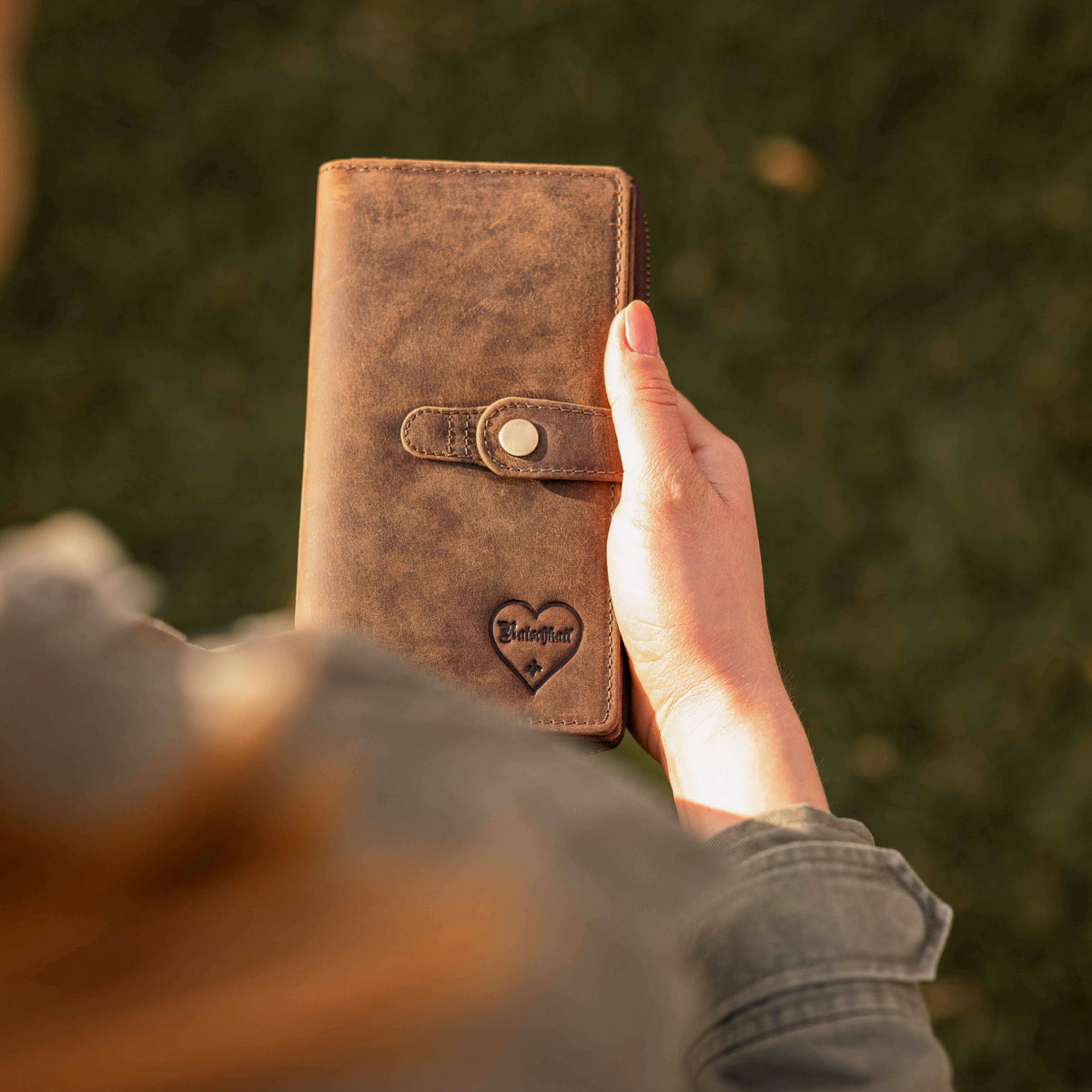


The back pocket is the worst place for a wallet — and yet that is exactly where most men keep it. It presses when you sit, slips when you stand up, and in the crush of a beer tent or a festival nobody notices when it suddenly goes missing. On a motorcycle there is one more thing: whatever falls out of your trouser pocket ends up somewhere between two town signs. The chain wallet is the old, uncomfortably honest answer to all that. It hangs from your belt loop and goes nowhere you don't go too.
This guide clears up who really benefits from a chain wallet and for whom it just means weight and rattling. You will learn how chain, carabiner and lanyard differ, which length makes sense, how the attachment to the belt loop holds, why the long format is the better build for chains, what the chain actually does against pickpockets — and when you are better off buying without a chain. At the end there is a comparison table with chain and carabiner models from our range as well as alternatives without a chain.
Who a chain wallet is made for
The chain wallet is not a fashion item but a tool. It suits people who move a lot, sit down and stand up often, work with both hands or spend time in dense crowds. Five groups benefit in particular.
Motorcyclists
The classic case. Getting on, putting a foot down at the lights and getting off, a wallet in the back pocket slides a little further out every time. Add to that leather or textile trousers with a smooth lining where nothing finds any grip. With a chain, the wallet hangs from the belt loop; even if it slips out of the pocket, it dangles at your leg instead of falling onto the road. The price for that is further down: the chain can scrape against the tank.
Tradespeople and the building site
If you spend the day bending, kneeling, climbing ladders and wearing work trousers with wide, deep pockets, you lose your wallet not to theft but to gravity. When you kneel, the trouser pocket tips downwards; when you stand up, the wallet stays on the floor. A chain or a carabiner on the belt loop solves that without you having to think about it all day.
Festivals and concerts
Dense crowds, many hours on your feet, sleeping in a tent, trouser pockets that gape open when you sit on the ground. The festival is the situation where the chain pays off twice over: against losing it and against stray hands. And anyone living in the same trousers for several days doesn't want to pat down their pockets every evening to check that everything is still there.
Beer garden and folk festival
On a beer bench you sit close together, get up constantly, shuffle along, and by the end of the evening there is at least one phone and one wallet under every bench. With lederhosen, the chain wallet is a familiar sight anyway — the long format fits the trouser pocket of traditional dress, and the chain hangs from the suspender buckle or the belt.
Hospitality and service
Here things are more nuanced. If you take payments in service, you need change, sorted notes and an order pad — for that, a waiter's wallet with a holster is the better solution than a chain wallet, because it sits on the belt and can be operated with one hand. In hospitality, the chain is worthwhile above all for your own wallet, which you don't want to lose in the rush, not for the till.
Chain, carabiner or lanyard: three ways of securing a wallet
Under „chain wallet" there are three different solutions that differ clearly in weight, durability and looks.
The metal chain is the most robust option. It doesn't tear, can't be cut through and lasts for years. In return it is heavy, rattles quietly with every step and can scuff surfaces. If you wear it every day, you get used to the weight; if you only need it at the weekend, look for a detachable version. Our long format chain wallet Lenz has a detachable metal chain and is therefore suited to both.
The carabiner is the lightweight option. Instead of a chain, the wallet hangs directly from a hook on the belt loop, the backpack or the bag. It adds hardly any bulk, makes no noise and can be released in a second. The downside: the wallet hangs on the outside of the body or in an outer pocket, which makes it more visible. The carabiner wallet is our compact model of this type — with a coin compartment, six card slots and two key fobs, so your keys and wallet hang from one hook.
The lanyard made of fabric or leather is the discreet solution. It weighs almost nothing, scratches nothing and looks less martial on cloth trousers than a chain. But it is also the weakest link: a fabric strap can be cut through, a leather strap tears at the seam if someone yanks it. It is enough to protect against losing the wallet, but as theft protection it is the weakest of the three.
As a rule of thumb: motorcycle and building site take the chain, everyday life and travel take the carabiner, and if you mainly want the chain to stop you leaving the wallet on a café table, a strap will serve you well.
Length, attachment and detachability: what to look for when buying
The right chain length
The chain must be long enough that you can pull the wallet out of your pocket, open it and pay without unhooking it — and short enough that it doesn't knock against your knee when you walk. As a guide, 30 to 45 centimetres has proven itself. Shorter and paying gets awkward; longer and the chain hangs in a loop at your thigh, catches on things and scuffs. Before buying, measure once from your belt loop to the middle of your back pocket and add a hand's width.
Attachment to the belt loop
On the trouser side, the chain usually ends in a carabiner or a swivel with a hook. The carabiner must open with one hand and must not be so small that it levers itself out of the loop under tension. A swivel in between prevents the chain from twisting and knotting when you sit. On the wallet side, the chain sits on a ring or an eyelet riveted through the leather — not just glued or sewn on. Pull on it before you buy: if the leather puckers there, the connection won't survive a fall.
If you have no belt loop — jogging bottoms, shorts with an elastic waistband, traditional trousers with suspenders — the suspenders or the bag remain as the anchor point. A carabiner copes with that more easily than a firmly riveted chain hook.
Detachable or fixed
For most buyers this is the most important criterion. A firmly riveted chain stays on forever and makes the wallet a pure motorcycle or work wallet. A detachable chain you hook on in the morning and unhook again for dinner at a restaurant. If you only want to own one wallet, buy detachable; if you already have a second wallet for suit and office, you can afford the fixed version. With detachable chains, make sure the hook on the wallet isn't so big that it gets in the way without the chain.
Weight and scratches: the chain on the motorcycle tank
This is the point hardly any seller mentions. A metal chain weighs noticeably, and when riding it hangs exactly where the knee touches the tank. Over a season that leaves scratches in the paint. Three things help: choose the chain short enough that it lies taut when you sit and doesn't swing; put the wallet in the back pocket on the side facing away from the tank; or take the chain off while riding and only hook it on when you get off. If you regularly scrape the tank, treat yourself to a tank pad — it's cheaper than a paint repair.
Long format or landscape format with chain
Most chain wallets are built in long format, and there is a mechanical reason for that. A long format wallet sits upright in the back pocket, the chain sits at the top edge and pulls the wallet in the direction it already lies in the pocket. If someone pulls on it — or you yourself when standing up — it slides out lengthways without jamming. With a landscape format, the chain hangs from one corner, the wallet twists as it comes out, jams on the edge of the pocket and the leather scuffs at the eyelet.
Then there is the space: in long format the card slots sit one above the other instead of side by side, notes lie unfolded, and a clear window for your driving licence fits in without making the wallet wider. For motorcyclists, a visible driving licence is no luxury. Which build suits what is explained in the guide Men's wallets: which format for what in more detail.
Landscape format with a chain makes sense if the wallet is carried in a jacket pocket rather than in the trousers: there it lies flat, and the pull of the chain goes upwards out of the pocket. For jeans and lederhosen, the long format remains the better choice. In our range, all chain wallets and carabiner wallets are accordingly built upright.
Security: what the chain does against pickpockets — and what it doesn't
First, some perspective: most wallets are not lost to theft but to being left behind and slipping out. Against that, the chain helps reliably. With theft, the situation is different. A practised pickpocket pulls the wallet out of your pocket in a moment of distraction; with a chain, you notice immediately because it tugs. That is the real protection: not that the chain is indestructible, but that it makes unnoticed removal impossible. Anyone who tries anyway has to pull, and that gets noticed.
What the chain doesn't do: it doesn't protect against a knife cutting through the pocket, and it doesn't replace a look at what is actually in the wallet. If you carry your bank card, driving licence, ID card, health insurance card and 200 euros in cash, losing it is a bigger problem than losing the leather. What really needs to go in and what can stay at home is covered in the guide What belongs in a wallet — and what doesn't?. The chain is the second level of security; the first is not taking too much with you.
When a chain doesn't make sense
A good guide also says who it doesn't want to sell to. Three cases in which the chain wallet is the wrong choice:
Suit and office. A chain on a suit looks like a tool belt at dinner. It doesn't match the clothing, it rattles in meetings, and in a jacket pocket the wallet has no reason to disappear anyway. If you wear a suit by day and ride a motorcycle in the evening, you are better off with a detachable chain or two wallets than with a compromise that gets in the way in both places.
The inside pocket. If you carry your wallet in the inside pocket of a jacket or coat, it is already safe there: the pocket is closed, lies against the body and can't be reached from outside. A chain would have nothing to hold here. What you need for the inside pocket is a slim long format wallet that doesn't add bulk — for example the long format wallet Bayern Lenz, the same basic shape as the chain wallet, just without the chain, or if you carry a lot, one of the models from the collection large wallets.
The ladies' handbag. In a handbag, the wallet already lies in a closed container, and a chain would only get tangled up with keys, headphone cables and everything else. What counts here is a zip on the coin compartment so that nothing falls out when the bag tips over — not securing it to the outside. For the handbag, a chain is simply the answer to a question nobody asked.
And one more quiet drawback for everyone: a chain demands a belt loop. If you often wear trousers without loops, you end up hooking the chain nowhere and are left with just the weight. Then a carabiner or a wallet without any securing is the more honest solution. You will find the whole range without a chain under men's wallets.
Care: leather and chain last different lengths of time
You care for the wallet itself like any leather wallet: wipe off dust and sweat occasionally with a dry cloth, apply a thin layer of leather grease or leather balm two to three times a year, let it soak in, rub off the excess. Never dry a wet wallet on the radiator, but at room temperature. All the steps in detail are in the guide Caring for a leather wallet.
Two spots deserve extra attention on a chain wallet. First, the eyelet where the chain sits: that is where the chain works in the leather with every step, and that is where the first signs of wear show. A little grease at this spot keeps the leather supple, and when you take the chain off, take it off at the hook and not by pulling on the eyelet. Second, the chain itself: metal doesn't rust as long as it stays dry, but sweat and rain take their toll. After a wet day, wipe it down once, if needed a drop of sewing machine oil on the links — and never lay the oiled chain directly on the leather, that leaves stains. The carabiner on the trousers needs the least: if it gets stiff, blowing it out helps rather than oil, otherwise the dust sticks all the more.
Conclusion
A chain wallet is worth it for motorcyclists, tradespeople, festival-goers and everyone who spends more time on beer benches than at a desk. It keeps the wallet on your body, makes unnoticed pulling impossible and costs you weight and a little noise in return. If you only want to own one wallet, take a detachable chain in long format; if you like it light and quiet, go for the carabiner; if you carry your wallet in an inside pocket or handbag anyway, leave the chain out. The table above puts our chain and carabiner models and the alternatives without a chain side by side — each made of genuine leather and handmade, as befits a family business since 1947.